HAMAMATSU R580 Photomultiplier Tubes
( Brand: Hamamatsu ), ( Manufacturer Part Number: R580 ), ( Part Type: Tube )
Review HAMAMATSU Photomultiplier Tubes
Hamamatsu R580 Photomultiplier Tubes High-Performance Detection for Your Optoelectronic Applications
The Hamamatsu R580 Photomultiplier Tubes are a testament to precision and reliability in the realm of photon detection. Designed and manufactured by the renowned Japanese optoelectronics company, Hamamatsu Photonics, these tubes are trusted by scientists, researchers, and engineers worldwide for their exceptional performance and versatility.
The R580 series features a photocathode with a peak sensitivity at 420 nm, making it an ideal choice for applications that require ultraviolet and blue light detection. The photocathode material, a sensitive bialkali mixture, ensures high quantum efficiency, enabling the tube to convert a significant fraction of incoming photons into electrical signals.
The Hamamatsu R580 Photomultiplier Tubes boast a high gain of up to 8x10 6, ensuring a strong amplification of weak signals. This high gain, coupled with the low noise level, results in a high signal-to-noise ratio, improving the overall sensitivity and accuracy of your measurements.
The R580 tubes are equipped with a robust photomultiplier structure, consisting of a series of dynodes. These dynodes are designed to minimize internal photoemission, resulting in reduced dark current and increased stability over time. The tubes also feature a built-in base pulse shaper, ensuring a stable output pulse shape for precise signal analysis.
The Hamamatsu R580 Photomultiplier Tubes are housed in a compact, vacuum-sealed glass bulb with a beryllium window, ensuring excellent transmission of ultraviolet light. The tubes are designed for easy installation and long-term operation, with a mean time between failures (MTBF) of over 100,000 hours.
In conclusion, the Hamamatsu R580 Photomultiplier Tubes are an excellent choice for applications that demand high sensitivity, low noise, and long-term stability. Whether you're working in the fields of physics, chemistry, biology, or astronomy, these tubes can provide the precision and reliability you need for your optoelectronic experiments and measurements.
Hamamatsu R580 Photomultiplier Tubes (PMTs) are widely recognized for their high-quality and reliable performance in various scientific applications. Here are some pros and cons to consider:
Pros:1. High Quantum Efficiency: The Hamamatsu R580 PMTs offer a high quantum efficiency, allowing them to convert a large percentage of incoming photons into electrical signals. This makes them suitable for applications requiring high sensitivity.
2. Low Noise Level: These PMTs have a low dark count and low noise level, ensuring a high signal-to-noise ratio. This is crucial for obtaining accurate results in low light conditions.
3. Wide Dynamic Range: The Hamamatsu R580 PMTs have a wide dynamic range, enabling them to handle a broad range of light intensities.
4. Durable and Reliable: Hamamatsu is known for its quality and durability, and the R580 PMTs are no exception. They are built to withstand harsh experimental conditions and provide consistent performance over time.
Cons:1. High Cost: Compared to other PMTs, Hamamatsu R580 PMTs can be quite expensive. This might make them less accessible for researchers with limited budgets.
2. Requires Expertise for Proper Handling: PMTs can be sensitive to damage during handling and installation. Proper care and handling are necessary to ensure their long-term performance.
3. Potential for Afterpulsing: Some users have reported afterpulsing, which is a delay in the emission of secondary electrons after the initial photon event. This can lead to an overestimation of the signal.
In conclusion, Hamamatsu R580 PMTs are excellent choices for researchers who require high-quality, high-sensitivity PMTs for their experiments. Their high quantum efficiency, low noise level, and wide dynamic range make them suitable for a variety of applications. However, their high cost and the need for proper handling and maintenance are important factors to consider.
If budget allows and the experiment requires high sensitivity and precision, the Hamamatsu R580 PMTs would be a recommended choice. For researchers with limited budgets or less demanding applications, other less expensive PMTs might be more appropriate. It's always a good idea to thoroughly compare different options based on specific experimental requirements before making a purchase decision.
Details:
I try to schedule offers end when am where the item is ma w anode luminous sensitivity min. I live in two different cities. 34mm wave length short 300 NM long 650 peak 420 spectral response curve code 400k photo cathode material bi alkali window brisket glass denote structure linear-focused stages 10 max. Specifications type head-on tube size DOA.
Feel free to ask any questions. Shipping prices quoted are for the contiguous USA. 7 x 10⁴ a w anode gain typ.
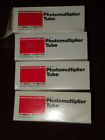
Listing is for the four tubes pictured. Typ ma anode to cathode supply voltage 1250 v luminous sensitivity min. Rating anode to cathode voltage 1750 v max.
A lam cathode blue sensitivity index cs typ. 38mm photo cathode area shape round size DOA.
10 a lam anode luminous sensitivity typ. Rating average anode current Na time response rise typ.
3 Na anode dark current after 30min. 7 NS time response transit typ. 1 x 10⁶ anode dark current after 30min a lam radiant sensitivity typ.
specifications industrlasemr:
- brand: Hamamatsu
- mpn: R580
- part type: Tube
Offer industrlasemr:
- bids: 0
- Started: March 29, 2018, 4:31 pm
- quantity: 1
- best offer: false
- Sold: 0
Ratings:
- A thanks 03-28-18
- Great price and fast shipping. Thanks! 03-29-18
- Excellent seller 03-29-18
- Weller EPH110 soldering tip arrived in good shape. 03-28-18
- As described A 03-27-18
Shipping industrlasemr:
- cost: $20.0
- handling: 10 days
- type: Flat
Payments industrlasemr:
- PayPal
Returns industrlasemr:
- policy: returns accepted
- paid by: Buyer
- details: Returns accepted for undamaged items, in the condition shipped, including packaging where applicable. Due to the high costs of shipping, I will not refund my shipping costs, except in cases of an error in the listing. Thanks for your understanding.
- type: Money Back
- time: 14 Days
Seller industrlasemr:
- zipcode: 87505
- city: Santa Fe, New Mexico
General industrlasemr:
- in stock: Yes
- businessindustrial > mroindustrial supply > lightinglasers > industrial lasers lighting lasers
- condition: New other see details
Hamamatsu R580 Is Similar To:
- 1p28-3 Hamamatsu Photomultiplier Photocathode Tube (71.1% similar) Thanks shipping is by free USPS priority, lower 48 states. See photos overall good clean condition, untested. You are buying on one used Hamamatsu 1P28-3 photomultiplier photo cathode tube plus cable...(January 20th, 2018)
- 1p28-4 Hamamatsu Photomultiplier Photocathode Tube (71.1% similar) See photos overall good clean condition, untested. Thanks shipping is by free USPS priority, lower 48 states...(October 30th, 2017)
- 1p28ha Hammamatsu Hamamatsu Photomultiplier Tube New Piece (65.3% similar) Hamamatsu photomultiplier tube 1P28HA LOC1173-29159...(May 28th, 2018)
- 402971 Hamamatsu Photomultiplier Tube (83.1% similar) Hamamatsu 1P28 photomultiplier tube removed from a working unit that was local university science lab. Please feel free to at: stores. No manuals, standard power cords, accessories, software etc are included unless pictured and noted in the. All equipment is sold-as-is...(June 17th, 2018)
- 6199 Hamamatsu Photomultiplier Tube Near (77.5% similar) Tech-harvester offerings...(June 23rd, 2017)
- 931a Hamamatsu Photomultiplier Tube W (80.5% similar) Elector Marvin is a 9-5 Mon-Fri business. Item condition: used - this is untested. Its often to late solve them if you wait. Listed for Marc. Problems are questions that were not asked before the offer closed...(October 2nd, 2017)
- 952870-01 Hamamatsu Photomultiplier Tube Pmt (81% similar) Shipping quote is for the USA...(June 25th, 2017)
- C1556-51 R105 Hamamatsu Photomultiplier Tube Amplifier Assembly (66% similar) This sale is for a laboratory surplus Hamamatsu model C1556-51 amplifier and R105 photomultiplier tube with the assembly shown in photos. Buyer to pay for shipping. This assembly was removed from a fully functioning piece of obsolete laboratory measuring system...(April 7th, 2018)
- C2761 Hamamatsu Photomultiplier Cooler (71.8% similar) Hamamatsu C2761 photomultiplier cooler cosmetic condition: unit has scuffing from average use...(March 26th, 2018)
- C2773 Hamamatsu Photomultiplier Cooler (71.8% similar) This is a Hamamatsu C2773 photomultiplier cooler it in good aesthetics condition. It powers up and not further tests were done. It came from a working system not manual included...(June 2nd, 2018)
- C4181-01 Hamamatsu Photomultiplier Assembly W-optics (65.2% similar) 30 day right of return if not satisfied. Photos show everything that is included...(October 21st, 2017)