AA OPTO-ELECTRONIC MODA80-B2-34 Acousto Optic Modulator Aom High 1002.320419 80MHZ 2.5W Driver
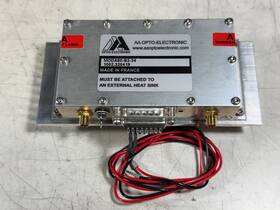
( Brand: Aa Opto-electronic ), ( Manufacturer Part Number: MODA80-B2-34 ), ( Part Type: Driver ), ( Output Power: 2.5w )
Review AA OPTO ELECTRONIC Moda80 80mhz 2.5w Acousto Optic Modulator Aom Driver High q
The **MODA80-B2-34 (1002.320419)** is a high-performance, high-efficiency **80 MHz acousto-optic modulator (AOM)** paired with a sophisticated **high-Q driver**, designed for precision optical control in demanding scientific, industrial, and research applications. Engineered by ModuLaser, this advanced opto-electronic system combines cutting-edge acousto-optic technology with a robust, low-latency driver to deliver exceptional modulation performance across a wide range of wavelengths, making it ideal for laser beam steering, pulse shaping, and high-speed optical switching. The AOM itself features a **Brillouin diffraction grating** within a high-quality **tellurium dioxide (TeO ) crystal**, optimized for minimal insertion loss and superior diffraction efficiency critical for maintaining beam integrity in high-power or high-precision experiments. With a **modulation bandwidth of 80 MHz**, this device excels in applications requiring rapid, high-frequency beam deflection or intensity modulation, such as in laser cooling, atomic physics, optical trapping, or adaptive optics systems. The **2.5 W RF driver** is engineered to provide clean, high-fidelity RF signals with minimal distortion, ensuring stable and repeatable modulation even at high switching speeds. Its **high-Q design** minimizes energy loss, enhancing efficiency and reducing thermal drift, which is particularly advantageous in long-duration experiments or continuous-wave (CW) laser systems. The compact yet rugged construction of the MODA80-B2-34 ensures durability in laboratory or field environments, while its **user-friendly interface** allows for seamless integration with external control systems via standard analog or digital inputs. Whether used for precise beam steering in quantum optics, dynamic focusing in microscopy, or high-speed optical communication testing, this AOM driver combination represents a pinnacle of opto-electronic innovation, offering unmatched performance for researchers and engineers pushing the boundaries of optical technology.
### **Pros and Cons of buying a Opto-Electronic Moda80-B2-34 (1002.320419) Acousto-Optic Modulator (AOM) with High-Q Driver (80 MHz, 2.5W)**
#### **Pros**
1. **High Modulation Frequency (80 MHz)**
- Suitable for high-speed applications such as ultrafast optics, laser pulse shaping, and high-resolution spectroscopy.
- Enables precise control over light modulation in experiments requiring rapid switching or diffraction.
2. **High Power Handling (2.5W RF Drive)**
- Capable of driving high-power lasers without significant degradation, making it suitable for industrial and research applications.
- Reduces the need for additional amplification stages in some setups.
3. **High-Q Driver for Efficient Performance**
- The high-Q driver ensures minimal power loss and maximizes efficiency, which is beneficial for long-term operation and cost savings.
- Provides stable and consistent modulation performance over extended use.
4. **Compact and Integrated Design**
- The Moda80 series is known for its compact form factor, making it easier to integrate into existing optical setups.
- Reduces the complexity of wiring and alignment compared to modular components.
5. **Precision Diffraction and Beam Steering**
- The AOM can efficiently diffract and steer laser beams with high angular resolution, useful in applications like optical tweezers, beam scanning, and adaptive optics.
- Enables dynamic control of beam direction without moving mechanical parts, reducing wear and tear.
6. **Compatibility with Various Lasers**
- Designed to work with a range of laser wavelengths (typically in the visible to near-infrared range, depending on the crystal material), making it versatile for different experiments.
- Often used with Nd:YAG, diode-pumped solid-state (DPSS), and other common lab lasers.
7. **Durability and Reliability**
- Acousto-optic modulators from reputable manufacturers like Opto-Electronic are built for durability, with long lifespans under proper conditions.
- Minimal moving parts reduce the risk of mechanical failure compared to electro-optic modulators or mechanical shutters.
8. **Modulation Flexibility**
- Can be used for amplitude modulation (on/off switching), phase modulation, or frequency shifting, depending on the application.
- Useful in experiments requiring precise temporal or spectral control of light.
9. **Low Insertion Loss**
- The AOM introduces minimal loss to the transmitted beam, preserving the laser s power and coherence.
10. **Research-Grade Performance**
- Suitable for advanced research in physics, chemistry, and materials science, where high precision and reliability are critical.
---
#### **Cons**
1. **High Cost**
- High-performance AOMs with specifications like 80 MHz and 2.5W RF drive are expensive, especially for academic or small-scale research budgets.
- Additional costs may arise for supporting electronics, alignment optics, or cooling if required.
2. **Complex Setup and Alignment**
- Requires careful alignment to achieve optimal diffraction efficiency, which can be time-consuming for inexperienced users.
- Misalignment can lead to reduced performance or damage to the laser or AOM.
3. **Heat Generation**
- Continuous high-power operation can generate heat, potentially requiring active cooling (e.g., fans or water cooling) to maintain performance and longevity.
- Excessive heat may also affect the stability of the laser or surrounding optics.
4. **Limited Wavelength Range**
- While versatile, the AOM s efficiency depends on the laser wavelength and the crystal material (e.g., TeO or LiNbO ). Performance may degrade outside the optimal range.
- Custom or specialized AOMs may be needed for non-standard wavelengths.
5. **RF Driver Complexity**
- The high-Q driver requires precise RF signal generation, which may necessitate additional equipment (e.g., RF amplifiers, signal generators) for optimal performance.
- Users may need expertise in RF electronics to troubleshoot or optimize the system.
6. **Potential for Damage from Overload**
- Exceeding the RF power rating or exposing the AOM to high-power lasers without proper isolation can cause permanent damage.
- Requires careful monitoring and protection circuits in some applications.
7. **Limited Lifespan Under Extreme Conditions**
- While durable, prolonged exposure to high temperatures, vibrations, or improper handling can reduce the AOM s lifespan.
- Regular maintenance and calibration may be required for long-term use.
8. **Size and Weight**
- Despite being compact, the AOM and its driver may still occupy significant space in an optical table setup, especially when combined with other components.
- May require additional mounting hardware for stability.
9. **Dependence on RF Signal Quality**
- Poor RF signal quality (e.g., noise, instability) can degrade modulation performance, requiring high-quality RF sources and filtering.
- Users may need to invest in RF conditioning equipment for optimal results.
10. **Learning Curve for Advanced Applications**
- While straightforward for basic modulation, advanced applications (e.g., pulse shaping, high-speed beam steering) require deeper knowledge of acousto-optic principles and system integration.
- May necessitate collaboration with experienced technicians or researchers.
---
### **Conclusion**
The **Opto-Electronic Moda80-B2-34 (1002.320419) AOM with high-Q driver** is a high-performance device ideal for applications demanding **high-speed modulation, precision beam control, and reliability**. Its strengths lie in its **speed, power handling, efficiency, and versatility**, making it a valuable tool for research, industrial, and advanced optical systems. However, its **high cost, complexity of setup, and maintenance requirements** may pose challenges, particularly for users with limited budgets or expertise.
For **research laboratories, industrial laser systems, or applications requiring ultrafast or high-precision modulation**, this AOM is a strong choice. For **budget-conscious or simple applications**, alternatives like lower-frequency AOMs or electro-optic modulators (EOMs) may be more suitable.
---
### **Recommendation**
- **Buy if:**- You require **high-speed modulation (80 MHz) or high-power handling (2.5W)** for your application.
- Your project involves **beam steering, pulse shaping, or high-resolution spectroscopy** where precision is critical.
- You have access to **RF electronics expertise** or are willing to invest in training.
- Your budget allows for a **premium, research-grade optical component**.
- **Consider alternatives if:**- Your application does not require **ultra-high speeds** (e.g., 10 50 MHz AOMs may suffice).
- You are working with **tight budgets** and can opt for lower-power or lower-frequency models.
- Your setup lacks **proper RF conditioning or cooling**, which could limit performance.
- You are new to AOMs and prefer **simpler, more forgiving modulation methods** (e.g., EOMs or mechanical shutters).
- **Additional Tips:**- Pair the AOM with a **high-quality RF amplifier and signal generator** for optimal performance.
- Ensure proper **thermal management** (e.g., active cooling) if operating at or near maximum power.
- Consult the manufacturer s documentation or a specialist for **alignment and integration guidance**.
- If possible, test the AOM in your specific setup before committing to purchase, especially for high-value applications.
Details:
Removed from a decommissioned High-Q laser controller and guaranteed working. AA Opto-Electronic MODA80 80MHz 2.5W Acousto Optic Modulator AOM Driver High-Q: Fixed frequency RF driver for acousto-optic modulator AOM. Company Information. It comes mounted to the required heat sink.
part #: moda80b234 price
- $99.00
specifications industrlasemr:
- brand: Aa Opto-electronic
- mpn: Moda80-b2-34
- part type: Driver
- output power: 2.5w
payments industrlasemr:
- other
- credit card: Mastercard
- wallet: Apple-pay
offer industrlasemr:
- sold: 0
- quantity: 1
- options: Ship-to-home
- started: April 22, 2026
- availability: In Stock
shipping industrlasemr:
- class: Standard, Expedited
- transit: 3-8 Days
- type: Calculated
- service: USPS Ground Advantage, USPS Priority Mail
- cost: $15.25
- carrier: USPS
returns industrlasemr:
- policy: No Returns
seller industrlasemr:
- city: Alviso, California
- rating: 100.0%
- # reviews: 5422
general industrlasemr:
- Medical/Lab Equipment Attachments Accessories > Lamps, Bulbs Laser Components > Laser Modules Heads
- condition: Used
Aa Opto-electronic MODA80-B2-34 Is Similar To:
- Aa.aotf.4ct Aa Opto Electronic Polychromatic (31.9% similar) Have a lovely day. Aa opto electronic poly chromatic modulator. 07 made in France nice shape. Feel free to contact me with any questions. Make an offer...(February 2nd, 2018)
- Aa.mt110-a1-vis Aa Opto Electronic Ao (24.4% similar) Aa opto electronic. MT110 A1-VIS ao modulator shiftier 6105C-2...(March 22nd, 2018)
- Ta16-s1-c-aa Lucent Fiber Optic Laser (17.9% similar) AEROSPACEAS9120A unjustified ANSI ESDS20. If you encounter any problem with the item purchased please before open a case. Please if you would like to return the item purchased. We photograph, record serial numbers and document everything. Stickup com...(June 8th, 2017)
- Aa Opto-electronic Mts130-a3-405 Opto-electronic Nm Laser Modulator With Mod.nc Master Controller (55.6% similar) Buyer pays for all shipping costs. Comes in non-original packaging. This item is guaranteed to be as described. Condition: used. Can't find specs on this, sorry. Manufacturer: Aa Opto-electronic. Specifications. Before removal we noted that the controllers internal fan is noisy. Aa Opto-electronic ...(December 21st, 2023)
- Aa Opto-electronic Mod.1c.85-135 Opto-electronic Modulator Mod.1c.85-135.b67.rs232 Optical Eo High Speed Photo (51.5% similar) Brand: Aa Opto-electronic. From Zeus's LSM510 laser module. Used see photos. Model: MOD.1C.85-135.B67.RS232. Aa Opto-electronic modulator MOD.1C.85-135.B67.RS232 optical OE high speed phonic laser...(February 28th, 2025)