MIDWEST OPTICAL BP470-S27.7 Light Bandpass Filter 425-495NM 27.7MM
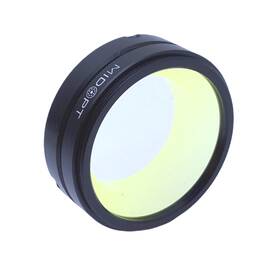
( Brand: Midwest Optical ), ( Manufacturer Part Number: BP470-S27.7 ), ( Part Type: Light Filter )
Review MIDWEST OPTICAL Blue Light Bandpass Filter 425-495nm 27.7mm
The **Midwest Optical BP470-S (27.7mm) Bandpass Filter (425 495nm)** is a precision-engineered optical component designed for demanding applications in fluorescence microscopy, spectroscopy, and scientific imaging where selective light transmission is critical. This high-quality bandpass filter operates within a narrow spectral range, isolating wavelengths between **425 and 495 nanometers** with exceptional clarity and minimal stray light interference. Crafted from superior optical glass and coated with proprietary multilayer dielectric thin-film technology, the BP470-S ensures near-perfect transmission of its designated bandwidth while effectively blocking all other wavelengths, including harmful UV and infrared radiation. The filter s **27.7mm diameter** makes it compatible with a wide range of microscope objectives, cameras, and optical setups, including those used in fluorescence imaging of biological samples, such as GFP (Green Fluorescent Protein) or other fluorophores emitting in the blue-green spectrum. Its **steep rejection slopes** on either side of the passband typically exceeding **OD4 (0.0001% transmission)** outside the 425 495nm range minimize spectral leakage, ensuring clean, high-contrast imaging and accurate spectral analysis. Ideal for researchers, scientists, and professionals in fields like cell biology, materials science, and photonics, this filter is built to withstand rigorous use while maintaining consistent performance over extended periods. Whether integrated into a fluorescence microscope, a spectrograph, or a custom optical system, the BP470-S delivers reliable, high-precision light isolation, making it an indispensable tool for experiments requiring precise spectral control.
The **Midwest Optical BP470-S 27.7mm Bandpass Filter (425 495nm)** is a specialized optical filter used primarily in astronomy, fluorescence imaging, and other applications requiring precise light isolation. Below is a detailed breakdown of its pros and cons, followed by a conclusion and recommendation.
---
### **Pros**
1. **High Optical Quality and Precision**
The filter is manufactured by Midwest Optical, a reputable company known for producing high-precision optical components. The bandpass design (425 495nm) is tightly controlled, allowing for effective isolation of the desired wavelength range while blocking most out-of-band light. This is critical for applications like narrowband astrophotography (e.g., capturing the H-beta emission line at 486nm) or fluorescence microscopy.
2. **Durable and Stable Construction**
Midwest Optical filters are typically made with high-quality glass substrates and precision-coated with multi-layer dielectric films. This ensures long-term stability, resistance to scratching, and minimal degradation over time, especially when handled properly.
3. **Compatibility with Common Optical Systems**
The 27.7mm diameter is a standard size for many astronomical and laboratory setups, including telescope eyepieces, camera adapters, and microscope attachments. This makes it easy to integrate into existing equipment without requiring custom modifications.
4. **Narrow Bandwidth for Specific Applications**
The 425 495nm range is useful for targeting specific emission lines or fluorescence signals. For example:- **Astrophotography:** Capturing the H-beta line (486nm) in nebulae like the North America Nebula (NGC 7000) or the Veil Nebula.
- **Fluorescence Imaging:** Exciting certain fluorophores that emit in this range (though many biological fluorophores fall outside this band, it may still be useful for specific dyes or custom setups).
- **Light Pollution Reduction:** While not a perfect light pollution filter, it can help isolate celestial objects with strong emissions in this range while blocking some artificial light.
5. **Affordable for a Specialized Filter**
Compared to some high-end astronomical filters (e.g., custom-made or ultra-narrowband filters), the BP470-S is reasonably priced, making it accessible for hobbyists and researchers on a budget.
6. **Minimal Light Loss in the Passband**
High-quality bandpass filters are designed to maximize transmission within the passband (425 495nm) while blocking adjacent wavelengths. This ensures that the captured signal is strong and clear, though some loss may occur depending on the filter s exact specifications.
---
### **Cons**
1. **Limited Use Case for General Astrophotography**
The 425 495nm range is not ideal for capturing the most common deep-sky objects, which often emit in broader bands (e.g., H-alpha at 656nm, O-III at 496/501nm). While it can be useful for H-beta imaging, it is not a versatile filter for general nebula photography. Users targeting other emission lines (e.g., O-III) would need a different filter.
2. **Potential for Overlap with Atmospheric or Light Pollution**
Some artificial lights (e.g., sodium vapor lamps) emit in the yellow-orange range ( 589nm), but this filter does not block them effectively. Additionally, moonlight and some types of light pollution may still interfere, reducing contrast in urban or suburban locations. For serious light pollution reduction, a dedicated narrowband filter (e.g., H-alpha or O-III) is often better.
3. **No Blocking of Nearby Wavelengths Outside the Passband**
While the filter is designed to pass 425 495nm, it may not provide complete blocking of wavelengths just outside this range (e.g., 400 425nm or 495 500nm). This could lead to some leakage of unwanted light, particularly in applications requiring extreme isolation (e.g., high-contrast fluorescence imaging).
4. **Potential for Chromatic Aberrations**
Some bandpass filters, especially those with steep edges, can introduce minor chromatic aberrations or vignetting when used with certain optical systems (e.g., wide-field cameras or refractors with strong chromatic aberrations). This is more of an issue with lower-quality filters, but it s worth testing if precision is critical.
5. **Not Ideal for Broad-Spectrum Applications**
If you re looking for a filter that captures a wide range of celestial objects (e.g., galaxies, star clusters, or general nebulae), this narrow bandpass filter will not be suitable. It is specialized and may not provide a "natural" view of the sky.
6. **Requires Proper Alignment and Handling**
Like all optical filters, the BP470-S must be handled carefully to avoid scratches or dust contamination, which can degrade performance. Improper installation (e.g., not sealing the filter properly in a filter wheel or adapter) can also introduce issues like light leaks or misalignment.
---
### **Conclusion**
The **Midwest Optical BP470-S 27.7mm Bandpass Filter (425 495nm)** is a well-made, precision-engineered filter with clear strengths in niche applications such as H-beta astrophotography or specific fluorescence imaging tasks. Its high optical quality, durability, and compatibility with standard optical setups make it a solid choice for users with targeted needs.
However, its limitations particularly its narrow applicability to only a few specific emission lines and its inability to address broader astrophotography goals mean it is not a versatile filter for general use. If your primary goal is capturing H-beta nebulae or working with fluorophores that emit in this range, the BP470-S is an excellent and cost-effective option. For other applications (e.g., O-III imaging, light pollution reduction, or general viewing), a different filter would be more appropriate.
---
### **Recommendation**
- **Buy the BP470-S if:**- You are specifically targeting H-beta emission lines in astrophotography (e.g., imaging the North America Nebula, Veil Nebula, or other H-beta-rich nebulae).
- You are working with fluorescence microscopy or another application requiring precise isolation of the 425 495nm range.
- You need a reliable, high-quality filter for a specialized setup and are willing to accept its limitations.
- **Avoid the BP470-S if:**- You are a beginner or general astrophotographer looking for a filter that captures a wide range of nebulae (e.g., H-alpha, O-III, or broad-spectrum filters like an Astronomik CLS).
- You are in a light-polluted area and need a filter that actively reduces artificial light (narrowband H-alpha or O-III filters are better for this).
- You plan to use it for visual observation rather than imaging (bandpass filters are primarily designed for photography).
- **Consider Alternatives:**- For **H-beta imaging**, the BP470-S is a good choice, but ensure your target objects have strong H-beta emissions.
- For **O-III imaging**, use a dedicated O-III filter (e.g., Astronomik 12nm O-III or Optolong L-eXtreme).
- For **light pollution reduction**, a dual-band (H-alpha O-III) filter is more effective.
- For **fluorescence imaging**, verify that your fluorophores emit within the 425 495nm range, as many common dyes (e.g., FITC, GFP) fall outside this band.
In summary, the BP470-S is a **specialized tool** with clear pros for its intended applications but is not a jack-of-all-trades filter. Purchase it with a clear understanding of its limitations and ensure it aligns with your specific project requirements.
Details:
Overall OD: 42.5mm. This is a surplus item. Midwest Optical. Slip Mount: 27.7mm.
Specifications: model #: BP470-S27.7. Filter Range: 425-495nm.
part #: bp470s277 price
- $75.00
specifications industrlasemr:
- brand: Midwest Optical
- mpn: Bp470-s27.7
- part type: Light Filter
offer industrlasemr:
- availability: In Stock
- options: Ship-to-home
- quantity: 1
- best offers: True
- sold: 0
- started: May 1, 2026
shipping industrlasemr:
- transit: 3-5 Days
- class: Standard, Expedited, One-day
- type: Calculated
- cost: $0.00
- service: USPS First Class, USPS Priority Mail Padded Flat Rate Envelope, UPS Next Day Air
- carrier: USPS, UPS
payments industrlasemr:
- cash
- credit card: Mastercard
- other
- wallet: Apple-pay
seller industrlasemr:
- rating: 100.0%
- # reviews: 45493
- city: Osseo, Minnesota
general industrlasemr:
- Medical/Lab Equipment Attachments Accessories > Lamps, Bulbs Laser Components > Other Medical/Lab Equipment Lamps Bulbs
- condition: Used
returns industrlasemr:
- time: 30 Days
- method: Money back
- paid by: Seller
- policy: Returns Accepted
Midwest Optical BP470-S27.7 Is Similar To:
- Midwest Optical Sp700-58 Midopt Near Ir Dichroic Block (36.8% similar) Comes in original case. See photos for details...(February 5th, 2026)
- Midwest Optical Bp635-s27.7 Light Red Bandpass Filter 615-645nm 27.7mm (85.1% similar) Filter range: 615-645NM. Overall OD: 42.5MM. Specifications: model #: BP635-S27.7. Slip mount: 27.7MM. This is a surplus item. Midwest Optical...(April 28th, 2026)