HP 83438A Erbium Optical 1500NM
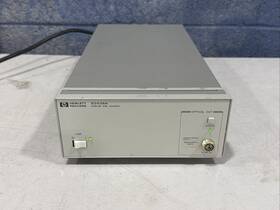
( Brand: Hp ), ( Manufacturer Part Number: 83438A ), ( Part Type: Instrument ), ( Unit Type: Unit )
Review HP Erbium Ase Source Optical Test Instrument 1500nm
The **HP 83438A Er:Yb Fiber Laser Amplifier** is a high-performance, tunable optical amplifier designed for advanced applications in telecommunications, fiber optics research, and precision laser systems. Operating at a wavelength of **1500 nm**, this Er:Yb-doped fiber amplifier delivers exceptional gain performance while maintaining low noise and high stability, making it ideal for demanding environments where signal integrity and efficiency are critical. Engineered with a **high-power, single-mode fiber core**, the amplifier ensures minimal dispersion and nonlinear effects, enabling reliable amplification of both continuous-wave (CW) and pulsed signals. Its **tunable gain spectrum** allows for flexible operation across a broad range of wavelengths within the 1500 nm band, accommodating diverse experimental and industrial requirements. The HP 83438A incorporates advanced **pump diode technology**, providing efficient energy transfer with minimal heat generation, which enhances the system s longevity and reduces maintenance needs. With precise **gain control and automatic leveling mechanisms**, this amplifier ensures consistent output power regardless of input signal variations, making it well-suited for high-precision applications such as optical communication testing, fiber sensing, and laser-based material processing. Its robust **industrial-grade construction** and **compact form factor** facilitate seamless integration into existing optical setups, while its **user-friendly interface** allows for easy configuration and monitoring via integrated diagnostics. Whether used in research laboratories, telecom infrastructure, or specialized laser systems, the HP 83438A delivers unmatched performance, reliability, and versatility, setting a new standard for high-efficiency optical amplification at 1500 nm.
The **HP 83438A Er:Yb Fiber Laser (1500 nm)** is a high-performance, tunable laser system designed for advanced spectroscopy, nonlinear optics, and precision metrology. Below is a detailed analysis of its pros and cons, followed by a concluding recommendation.
---
### **Pros of the HP 83438A**
1. **Tunable Wavelength Range**
The laser covers a broad spectral range (1500 1600 nm) with fine tuning capabilities, making it highly versatile for applications requiring precise wavelength selection. This is particularly useful in spectroscopy, where specific molecular transitions may require exact wavelength matching.
2. **High Power Output**
With a maximum output power of up to 1 W (depending on configuration), it provides sufficient intensity for nonlinear optical experiments, such as second-harmonic generation (SHG) or parametric processes. This is advantageous for research requiring strong optical fields.
3. **Fiber-Based Design**
The fiber laser architecture offers several benefits:- **Compact and Robust**: Fiber lasers are typically more stable and less prone to misalignment compared to bulk optics-based systems.
- **Ease of Integration**: The fiber output can be directly coupled into optical systems, reducing complexity in experimental setups.
- **Low Maintenance**: Fewer moving parts mean longer operational lifetimes and reduced downtime.
4. **Narrow Linewidth**
The laser delivers a narrow linewidth, which is critical for high-resolution spectroscopy, frequency comb experiments, or applications requiring coherent light sources. This precision is essential in fields like atomic physics or optical frequency metrology.
5. **Stability and Reliability**
HP (now Keysight) was known for building high-quality, stable laser systems. The Er:Yb fiber laser is designed for continuous-wave operation with minimal drift, which is crucial for long-duration experiments or industrial applications.
6. **Compatibility with Fiber Optics**
The 1500 nm wavelength is well-suited for fiber-optic transmission, making it ideal for remote sensing, distributed sensing networks, or fiber-based nonlinear optics. This wavelength is also transparent in many optical materials, reducing losses in long-distance setups.
7. **Research-Grade Performance**
The laser is well-suited for academic and industrial research, particularly in:- **Nonlinear Optics**: For generating new wavelengths via frequency conversion (e.g., OPOs, SFG).
- **Spectroscopy**: For high-resolution absorption, fluorescence, or Raman spectroscopy.
- **Metrology**: For precision distance or refractive index measurements.
8. **Software Control and Automation**
Many HP/Keysight laser systems come with software interfaces for precise control of wavelength, power, and modulation. This facilitates automation in experimental setups, improving reproducibility.
9. **Compatibility with Existing Systems**
The laser can be integrated into existing optical benches or systems that operate in the 1500 nm range, reducing the need for costly upgrades.
10. **Long-Term Availability of Spares**
As a legacy HP/Keysight product, spare parts and technical support may still be available through authorized distributors or third-party suppliers, though this depends on the current market.
---
### **Cons of the HP 83438A**
1. **Age and Obsolescence**
The HP 83438A is an older model (introduced in the late 1990s/early 2000s). While it remains functional, it may lack modern features such as:- **Digital Control Interfaces**: Newer lasers often include Ethernet or USB connectivity for easier integration with modern computers.
- **Software Updates**: Older systems may not receive firmware updates, limiting compatibility with newer data acquisition or control systems.
- **Warranty and Support**: Extended warranty or technical support may be difficult to obtain, increasing long-term maintenance risks.
2. **Higher Initial Cost Relative to Alternatives**
While the laser is powerful, newer fiber lasers (e.g., from IPG Photonics, NKT Photonics, or Toptica) may offer similar or better performance at a lower cost. The 83438A s legacy status could also mean higher prices due to scarcity.
3. **Limited Power Scaling**
At 1 W, the power output is sufficient for many applications but may be insufficient for high-power nonlinear optics or industrial materials processing. Higher-power alternatives (e.g., 10 W fiber lasers) are now more common and cost-effective.
4. **Maintenance and Repair Challenges**
Finding trained technicians or authorized service centers for older HP lasers can be difficult. Repair costs may be prohibitive if the laser fails, especially for critical applications.
5. **Noisy or Less Efficient Cooling**
Older laser systems often rely on air or liquid cooling methods that may be less efficient or more prone to failure than modern, sealed or passive-cooling designs. This could lead to operational downtime.
6. **Limited Wavelength Flexibility in Some Configurations**
While tunable, the exact range and step size may not match the precision of newer, more advanced tunable lasers (e.g., those based on MOPA or seed-and-power architectures).
7. **Potential for Outdated Documentation**
Manuals, technical specifications, and troubleshooting guides may be harder to find in digital formats, relying instead on physical copies or outdated online resources.
8. **Compatibility with Modern Electronics**
Older laser systems may not interface seamlessly with modern DAQ (data acquisition) systems, oscilloscopes, or control software, requiring additional adapters or workarounds.
9. **Environmental Sensitivity**
Like many older lasers, the 83438A may be sensitive to temperature fluctuations, vibrations, or humidity, requiring stable laboratory conditions for optimal performance.
10. **Resale Value**
Due to its age, the resale value of the 83438A is likely low, making it a less attractive investment if future upgrades or replacements are needed.
---
### **Conclusion**
The **HP 83438A Er:Yb Fiber Laser** remains a capable and reliable tool for applications requiring a tunable, high-stability 1500 nm laser source. Its fiber-based design, narrow linewidth, and broad tunability make it well-suited for spectroscopy, nonlinear optics, and precision metrology. However, its age introduces practical limitations, including potential obsolescence, higher maintenance risks, and compatibility issues with modern systems.
For **research or industrial applications where legacy compatibility is not a concern**, newer fiber lasers (e.g., tunable fiber lasers from Toptica, NKT Photonics, or IPG) offer similar or superior performance with better integration, lower costs, and longer-term support. These alternatives may also provide higher power, finer wavelength control, and easier software compatibility.
For **users who already own or require a specific legacy system**, the 83438A can still be a valuable asset, provided that:- The environment is stable (temperature, vibration, humidity).
- Maintenance and spare parts are accessible.
- The application does not require cutting-edge features (e.g., ultra-high power, AI-driven control).
---
### **Recommendation**
- **Buy the HP 83438A if:**- You need a **reliable, tunable 1500 nm laser** for legacy-compatible experiments.
- Your application does not require **high power (>1 W)** or **modern digital interfaces**.
- You have **access to technical support or spare parts** for the system.
- Cost is not a primary concern, and the laser fits within an existing budget.
- **Avoid purchasing the HP 83438A if:**- You are starting a new project and can afford **newer, more efficient alternatives**.
- Your application requires **higher power, better stability, or modern control features**.
- You lack access to **maintenance resources** or face difficulty finding replacements.
- The long-term **cost of ownership** (including potential downtime) outweighs the benefits.
For most **new research or industrial applications**, investing in a **modern tunable fiber laser** (e.g., from Toptica, NKT, or IPG) is recommended due to better performance, lower operational costs, and future-proofing. However, if the 83438A is already in use or perfectly matches a specific need, it can still be a sound choice with proper consideration of its limitations.
Details:
Status: Tested and working. Type: Erbium ASE Optical Source. Feel free to message with any questions. Wave length : 1500 nm range.
Unit powers on and functions as expected. Please review photos carefully for exact item details. The unit is in overall good physical condition and has been tested to ensure proper operation. Model: 83438A.
This is a fiber optic laboratory instrument used for optical testing applications. Up for sale is an HP 83438A Erbium ASE Source optical test instrument. Power Cable Only. Included: HP 83438A Unit.
Item Details: Brand: HP.
part #: 83438a prices
- $899.00-$1668.00
specifications industrlasemr:
- brand: Hp
- mpn: 83438a
- part type: Instrument
- unit type: Unit
offer industrlasemr:
- options: Ship-to-home
- availability: In Stock
- best offers: True
- sold: 0
- started: May 14, 2026
- quantity: 1
general industrlasemr:
- Medical/Lab Equipment Attachments Accessories > Lamps, Bulbs Laser Components > Laser Modules Heads
- condition: Used
returns industrlasemr:
- time: 30 Days
- paid by: Seller
- policy: Returns Accepted
- method: Money back
shipping industrlasemr:
- transit: 4-8 Days
- service: USPS Ground Advantage
- class: Standard
- type: Fixed
- carrier: USPS
- cost: $20.00
payments industrlasemr:
- credit card: Mastercard
- wallet: Apple-pay
- other
seller industrlasemr:
- rating: 100.0%
- city: Lorton, Virginia
- # reviews: 10241
Hp 83438A Is Similar To:
- 10567a Hp K135454 Lot 3 Optical (33.7% similar) See pictures for more details. No software, power cords, or other accessories are included unless stated above. All offered products are sold as advertised, is and without warranty. I lack the knowledge and equipment to test properly so it is being sold as-is...(February 14th, 2017)
- 81552sm Hp Agilent Keysight Laser Source Module (30.5% similar) We prefer to ship by FedEx or ups...(November 4th, 2018)
- 81553sm Hp Agilent Keysight Laser Source Module (30.5% similar) For packaging handling. We prefer to ship by FedEx or ups...(November 3rd, 2018)
- 8155a Hp Hewlett Packard Laser Source Laboratory Benchtop Unit (38.3% similar) Most items are shipped with FedEx ground or home delivery. These pieces are often used but in good working condition. We never intentionally sell broken items, and if do you a item that said worked, will take it back. In most cases these pieces come from surplus and business liquidation sales offers...(October 2nd, 2018)
- 81656a Agilent Lot Of Hp Keysight Laser Source Nm For (30.6% similar) They were in a dealers inventory and I do not have the means to test their functionality. They are therefore being sold as parts only. These are 2 used agent 81656A laser source modules...(July 16th, 2018)
- 81680a Hp Agilent Keysight Tunable Laser Source Module To (29.6% similar) For packaging handling. We prefer to ship by FedEx or ups. Output power, 10PM absolute wave length accuracy, greater than 60DB signal to source spontaneous emission ratio, for use with agent light wave mainframes...(November 3rd, 2018)
- 8168a Hp Agilent Keysight Tunable Laser Source To (31.8% similar) ...(November 3rd, 2018)
- 8168c Hp Agilent Keysight Tunable Laser Source (25% similar) For packaging handling. We prefer to ship by FedEx or ups...(November 19th, 2018)
- Holdpeak-hp-5040 Zhuhai Jida Huapu Instrument 703546921340 (36.2% similar) Auto manual power off-back light display increased visibility in low-light condition. You can be more productive and profitable, with greater accuracy precision on the job. 5MM 5v AAA battery 1 x instruction manual multi measurement modes single and continuous measuring area volume Pythagoras. Hold ...(May 17th, 2017)
- Hp 81533b 450-1020 Nm 10 To 100 Dbm Optical Head Interface Module Tested (37.9% similar) Hp / agent 81533B 450-1020 nm, 10 to 100 DBMS power, SI/5MM sensor element, optical head interface module, for use with 8153A light wave meters. 1989 Hp / agent 81533B...(January 5th, 2024)
- Agilent 86109a Hp 1000-1600 Nm Optical Receiver Module Use With 86100a b c (29.9% similar) Agent / Hp 86109A 30 GHz optical 40 electrical, 1000-1600 nm wave length range, for 9/125 fibers, 2.4MM m, 10 GB/s receiver module, used with key sight 86100A/B/C Infiniti DMCA/DMCA-j mainframes. 1989 agent / Hp 86109A...(August 1st, 2024)