NEOS 48062-1-.55-1W Aotf Acousto Optic Tunable Filter Argon Line Laser
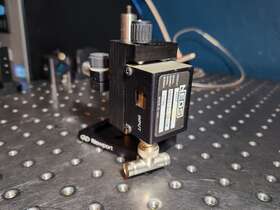
( Brand: Neos ), ( Manufacturer Part Number: 48062-1-.55-1W ), ( Part Type: Line Filter Laser ), ( Country/region Of Manufacture: United States )
Review NEOS Aotf Acousto optic Tunable Filter Argon Multi line Laser
Neos 48062-1-.55-1W AOTF Acousto-Optic Tunable Filter for Argon Multi-Line Laser
The Neos 48062-1-.55-1W Acousto-Optic Tunable Filter (AOTF) is a high-precision, sophisticated accessory designed specifically for Argon multi-line lasers. This AOTF serves as an essential tool for scientists, researchers, and technicians who require precise wavelength tuning in their experiments.
The Neos 48062-1-.55-1W AOTF employs advanced acousto-optic technology to modulate the light passing through it, allowing for the tuning of the laser's output wavelength. With a wide tuning range of 460-550 nm, this filter offers exceptional versatility, accommodating a broad spectrum of applications in spectroscopy, holography, and other fields that demand fine-tuned light sources.
This AOTF is equipped with a powerful 1W laser driver, ensuring stable and reliable operation. The driver delivers a continuous wave output with a maximum current of 500 mA, maintaining the filter's performance even under heavy usage. The filter itself boasts a high modulation speed, capable of responding to changes in wavelength within microseconds, making it ideal for applications requiring rapid wavelength tuning.
The Neos 48062-1-.55-1W AOTF is designed with durability in mind, featuring a compact and rugged construction that can withstand the demands of a laboratory environment. The filter is compatible with standard 25.4mm threads, allowing for easy integration into existing laser systems.
In conclusion, the Neos 48062-1-.55-1W Acousto-Optic Tunable Filter offers unparalleled wavelength tuning capabilities for Argon multi-line lasers. Its wide tuning range, high modulation speed, and robust construction make it an invaluable tool for researchers seeking precision and versatility in their optical experiments.
The Neos 48062-1-.55-1W AOTF (Acousto-Optic Tunable Filter) for Argon Multi-Line Laser comes with several advantages and potential drawbacks that are worth considering before making a purchase.
Advantages:1. Tunable wavelength range: The AOTF allows for the adjustment of the output wavelength, making it suitable for various applications that require different spectral lines from the Argon laser.
2. Fast wavelength switching: AOTFs can typically switch wavelengths much faster than other filtering methods, which is advantageous in applications that require rapid changes in the laser spectrum.
3. High stability: The AOTF offers good wavelength stability over time, which is important for maintaining the accuracy of experimental results.
4. Compact design: AOTFs are generally smaller and lighter than other optical filtering solutions, making them easier to integrate into various experimental setups.
Disadvantages:1. Cost: AOTFs can be more expensive compared to other filtering solutions, such as interference filters or Fabry-Perot etalons.
2. Limited tuning range: While the Neos 48062-1-.55-1W AOTF covers a broad range of spectral lines from the Argon laser, it may not be suitable for applications that require wavelengths outside this range.
3. Polarization dependence: Some AOTFs can be sensitive to the polarization of the incident light, which may cause unwanted effects in certain applications.
4. Potential for temperature-induced drift: AOTFs can be affected by temperature changes, which may lead to wavelength drift over time.
In conclusion, the Neos 48062-1-.55-1W AOTF offers several benefits, such as tunable wavelength range, fast wavelength switching, high stability, and compact design, making it an attractive option for various applications that require spectral control of an Argon multi-line laser. However, potential drawbacks, such as cost, limited tuning range, polarization dependence, and temperature-induced drift, should be carefully considered before making a purchase.
Recommendation: If the application requires rapid wavelength tuning and the spectral range covered by the Neos 48062-1-.55-1W AOTF is suitable, it could be a good choice due to its compact design and high stability. However, if cost is a concern or if the application requires a broader wavelength range, it may be worth considering alternative solutions like interference filters or Fabry-Perot etalons. It is essential to evaluate the specific requirements of the application and choose the filter solution that best fits those needs.
Details:
Retired from a milting argon laser system that produced 150mW.
specifications industrlasemr:
- brand: Neos
- mpn: 48062-1-.55-1w
- part type: Line Filter Laser
- country/region of manufacture: United States
general industrlasemr:
- Medical/Lab Equipment Attachments Accessories > Lamps, Bulbs Laser Components > Laser Modules Heads
- condition: Used
offer industrlasemr:
- options: Ship-to-home
- quantity: 1
- best offers: True
- availability: In Stock
- sold: 0
- started: October 14, 2023
seller industrlasemr:
- rating: 100.0%
- # feedbacks: 67
- city: Sacramento, California
ratings:
- laser seems to work OK. 04-01-23
- Fast payment, great ! Would be happy to do business with again! Thank you! 10-01-23
- Fast payment! Thanks for your business, Simply Medical 10-01-23
- Great find for me. quick shipping. Would buy from again. A 04-01-23
- great seller, absolutely excellent. Customer service is awsome. 04-01-23
shipping industrlasemr:
- transit: 8-13 Days
- type: Calculated
- cost: $0.00
- carrier: USPS
- service: USPS Ground Advantage
- class: Standard
payments industrlasemr:
- credit card: Mastercard
- wallet: Google-pay
returns industrlasemr:
- time: 60 Days
- paid by: Seller
- method: Money back
- policy: Returns Accepted
Neos 48062-1-.55-1W Is Similar To:
- 33041-25-2-1 Neos Industrial Laser Valve (28.3% similar) Standard shipping prices are only good for the lower 48 states. All parts, accessories, cables, etc. All parts, including accessories and cables are only included if pictured or listed in the. Do not discard the packaging. If you do receive the package, submit clear images of packaging box and ...(July 25th, 2017)
- 33080-16-.7-i Neos Industrial Laboratory Laser Head Block Module Assembly Parts (26.4% similar) USPS or ups ground. If you do receive the package, submit clear images of packaging box and damaged item from multiple angles. Neos q-switch industrial laboratory laser head block module assembly parts this offer only comes with what is pictured or listed in the. Model: on a scale from, with 10 ...(March 5th, 2018)
- 38027-50dspkrg Neos Rf Driver Laser (27.8% similar) No power cord included. Has some scuffs and scratches on surface. Please see photos for closer look. Item comes as pictured, was removed from a working environment, unit only. Selling unit only powers on, no further testing...(July 13th, 2016)
- 64040-75-.1-6ch Neos Driver Module Model Rack Mountable For Parts (31.7% similar) ...(March 1st, 2018)
- Neos Laser Driver Channel 50w 27mhz switch Yag Dual MQH027-50DMFPS-2S 39027-50dmfps-2ch-at1 (11.6% similar) It will need to be attached to a finned heat sink or a cooled plate in your application. This was removed from a high power diode pumped Yang laser system in excellent condition and is guaranteed working. Here for the complete user's manual. Please before buying if you require a different shipping ...(July 27th, 2015)
- Gooch And Housego I-qs027-4s4g-b5-ll2 New Housgo Neos Qs027-4s4g-b5 1064nm Laser Q-switch Module 27mhz 4mm (16% similar) Interaction material: fused silica. Stainless steel cooling channels. Improved thermal management. Designed for use in high power 1064NM nd:Yang lasers. Company information. High damage threshold. Superior corrosion resistance. Specifications. Water-cooling channel material: aluminum DE-ionized ...(November 29th, 2023)
- Gooch And Housego Neos R38027-50-dmpk-pl1 Gooch housego Rf Q-switch Driver For Yag Laser 27mhz 50w R38027-50dmpk-pl1 (36.7% similar) Hooch hoosegow Neos RF q-switch driver for Yang laser 27MHZ 50W R38027-50DMPK-PL1 R38027-50DMPK-PL1: hooch and hoosegow formerly Neos model R38027-50-DMPK-PL1 q-switch. Rf frequency: 27.12MHZ. Company information. Carefully extracted from a coherent evolution laser controller in good condition and ...(December 5th, 2024)
- Neos N38080-2dm Laser Driver Module (24.3% similar) Neos N38080-2DM laser driver module, used, good working and cosmetic condition...(April 21st, 2025)
- Neos 38040-10dmsp-2 Q-switch Rf Driver For Spectra Physics Laser J40 j80 40mhz 10w 38040-10dmsp (33.1% similar) Company information. Available with or without the mounting bracket. Neos q-switch RF driver for spectra physics laser J40/J80 40MHZ 10W 38040-10DMSP 38040-10DMSP: model 38040-10DMSP-2 driver removed from laser controller. These are wired to plug into a J40 / J80 type controller...(April 24th, 2025)
- Neos N38080-5dmsp Rf Q-switch Driver 80mhz 5w 38080-5dmsp For Spectra Physics Laser (35.6% similar) Output power is adjusted by a trumpet under cap on the side of unit near label. These operate at 80MHZ and produce up to 5W. Neos RF q-switch driver 80MHZ 5w 38080-5DMSP for spectra physics laser laser: now hooch and hoosegow q-switch driver removed from laser controller. Company information...(April 26th, 2025)
- Neos N31085-6am Laser Driver Module Serial 2033 (23.6% similar) The Neos laser driver module N31085-6AM serial 2033 is a product manufactured by Neos, designed for use in various laser applications. This module is specifically designed to power and control a laser, ensuring precise reliable performance...(October 20th, 2025)