QPC / OPG LASERS 4715-0000 Mopa Laser Chip Mount Lidar 1550NM 1W 3-PIN
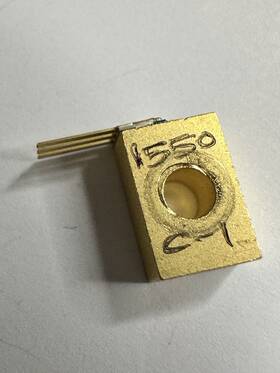
( Brand: Qpc / Opg Lasers ), ( Manufacturer Part Number: 4715-0000 ), ( Part Type: Laser Mount ), ( Output Power: 1 W ), ( Wavelength: 1550 Nm ), ( Intended Use/discipline: Lidar )
Review QPC / OPG LASERS 1550nm 1w Mopa Laser Chip C mount 3-pin Lidar Surplus
The **QPC Lasers OPG 4715-0000 1W 1550nm MOPA Laser Chip with C-Mount 3-Pin Lidar Interface** represents a cutting-edge, high-performance semiconductor laser module engineered for precision optical applications requiring reliable, high-power, and wavelength-stable output. Designed with advanced **Master-Oscillator Power-Amplifier (MOPA)** architecture, this laser chip delivers a **continuous-wave (CW) output of 1 watt at 1550nm**, a wavelength ideal for telecommunications, fiber optics, and long-range sensing due to its minimal attenuation in silica-based materials. The **1550nm emission** is particularly advantageous for applications in **LiDAR (Light Detection and Ranging), industrial metrology, free-space optical communication, and environmental monitoring**, where low divergence, high coherence, and excellent beam quality are critical. The **C-mount interface** ensures seamless integration into existing optical systems, accommodating standard lens mounts for precise beam collimation and focusing, while the **3-pin lidar-compatible connector** simplifies integration into LiDAR setups, offering compatibility with photodetectors, beam splitters, and scanning modules. Built with **high-efficiency semiconductor materials**, this laser chip minimizes thermal noise and maintains spectral purity, making it suitable for demanding applications where stability and consistency are paramount. Its compact yet robust design, combined with **low power consumption and long operational lifespan**, ensures durability in both laboratory and field deployments. Whether used for **high-resolution 3D mapping, autonomous vehicle sensing, or advanced optical ranging systems**, this laser chip provides a versatile, high-performance solution that bridges the gap between precision engineering and real-world functionality.
**Pros and Cons of buying a QPC Lasers OPG 4715-0000 (1550nm, 1W, MOPAS Laser Chip, C-Mount, 3-Pin for LiDAR Applications)**
### **Pros**
1. **High Power and Efficiency**
The 1W output power at 1550nm is suitable for many LiDAR and sensing applications, offering sufficient signal strength for distance measurement, imaging, or environmental sensing. The MOPAS (Master Oscillator Power Amplifier) architecture ensures stable, high-quality beam performance with minimal noise.
2. **Compatibility with LiDAR Systems**
The C-mount and 3-pin connector design aligns with common LiDAR module configurations, making integration into existing or custom systems easier. This reduces the need for additional optics or adapters in many cases.
3. **Wavelength Advantages**
The 1550nm wavelength is advantageous for certain applications due to its lower atmospheric absorption and scattering compared to shorter wavelengths (e.g., 800nm or 908nm). This can improve range and penetration in some environments, such as through foliage or in certain weather conditions.
4. **Compact and Modular Design**
The chip-based design suggests a compact form factor, which is beneficial for portable or space-constrained LiDAR setups. The modular nature may also allow for easier upgrades or replacements in the future.
5. **Potential for Customization**
QPC Lasers often provides customizable solutions, and this chip may be adaptable for specific modulation schemes, pulse widths, or beam profiles depending on the application. This flexibility can be valuable for research or specialized industrial uses.
6. **Reliability and Durability**
MOPAS lasers are generally known for their robustness and long operational lifetimes, especially when properly cooled and maintained. This can reduce downtime and maintenance costs over time.
7. **Support for Advanced Modulation**
The 3-pin connector likely supports external modulation (e.g., for frequency-shift keying or phase modulation), which is useful for Doppler LiDAR, velocity measurement, or advanced ranging techniques.
---
### **Cons**
1. **Cost**
High-power, wavelength-specific laser chips especially those designed for LiDAR can be expensive. The 1W output at 1550nm may represent a premium compared to lower-power or more common wavelengths (e.g., 850nm or 940nm). Budget constraints may limit adoption for small-scale or hobbyist projects.
2. **Thermal Management Requirements**
Maintaining stable performance at 1W output requires effective cooling, such as a thermoelectric cooler (TEC) or active cooling system. Poor thermal management can lead to wavelength drift, reduced power, or premature failure. This adds complexity and cost to the overall system design.
3. **Limited Availability of Documentation or Support**
Some specialized laser chips may lack comprehensive datasheets, application notes, or vendor support, particularly for niche markets like LiDAR. This can complicate troubleshooting or optimization of the system. Always verify the vendor s support resources before purchasing.
4. **Integration Challenges**
While the C-mount and 3-pin design are standard, ensuring compatibility with your specific LiDAR driver circuitry, optics, or housing may require additional components (e.g., collimators, lenses, or custom mounts). This can increase development time and cost.
5. **Wavelength-Specific Limitations**
The 1550nm wavelength may not be ideal for all applications. For example:- **Safety:** While 1550nm is generally considered safe for eye exposure (Class 1M), some regulatory environments may still require additional precautions.
- **Detector Compatibility:** Not all photodetectors (e.g., Si-based sensors) are sensitive at 1550nm; InGaAs or other infrared detectors may be needed, increasing system complexity.
- **Material Absorption:** Some plastics, fibers, or environmental conditions (e.g., water vapor) may absorb or scatter 1550nm light more than other wavelengths.
6. **Potential for Higher Noise or Jitter**
MOPAS lasers can sometimes exhibit higher phase noise or timing jitter compared to simpler diode lasers, depending on the design. This may affect the precision of LiDAR measurements, particularly in high-speed or Doppler applications.
7. **Supply Chain and Lead Times**
Specialized laser components may face longer lead times or supply chain risks, especially if the vendor serves multiple industries (e.g., telecom, medical, or defense). Always confirm stock availability and lead times before ordering.
8. **Learning Curve for Optimization**
Tuning a MOPAS laser for optimal performance (e.g., pulse shaping, modulation depth, or beam quality) may require expertise in laser physics or LiDAR system design. Beginners may need to invest time in testing and iteration.
---
### **Ending Conclusion**
The **QPC Lasers OPG 4715-0000 (1550nm, 1W, MOPAS, C-mount, 3-pin)** is a **high-quality, powerful laser chip well-suited for advanced LiDAR applications** where 1550nm performance is critical. Its MOPAS architecture ensures stability and efficiency, while the C-mount and 3-pin design facilitate integration into existing systems. However, the **higher cost, thermal management needs, and potential compatibility challenges** make it less ideal for budget-conscious or beginner projects.
This chip is **best recommended for:**- **Professional or industrial LiDAR systems** requiring long-range, low-scatter performance (e.g., environmental monitoring, automotive LiDAR, or scientific research).
- **Applications where 1550nm wavelength advantages** (e.g., reduced atmospheric loss, compatibility with fiber optics) are essential.
- **Developers with experience in laser integration** who can address thermal management, modulation, and detector compatibility.
For **hobbyists, low-budget projects, or applications where 800nm 908nm lasers suffice**, alternative options (e.g., standard DFB lasers or lower-power MOPAS chips) may offer better value. Always **verify vendor support, datasheet details, and system compatibility** before purchasing.
---
### **Final Recommendation**
**Buy this laser chip if:**You need a **reliable, high-power 1550nm source** for LiDAR with access to proper cooling and integration resources.
Your application **benefits from 1550nm s wavelength properties** (e.g., reduced scattering, fiber compatibility).
You are working on a **professional or research-grade system** where performance justifies the cost.
**Avoid this laser chip if:**You are on a **tight budget** or need a simpler, lower-cost solution.
Your LiDAR system **cannot accommodate thermal management** (e.g., no TEC or active cooling).
You lack **experience with laser integration** or require extensive customization.
Your application **does not require 1550nm** (e.g., short-range, visible-light LiDAR).
**Alternative Considerations:**- For **lower cost**, explore **800nm 908nm DFB lasers** or **lower-power MOPAS chips**.
- For **easier integration**, check **pre-packaged LiDAR modules** from vendors like **Lumentum, Coherent, or Thorlabs**.
- For **custom wavelength needs**, confirm QPC Lasers ability to modify specifications (e.g., power, modulation).
Details:
Wave length : 1550 nm. This is a bare laser component, not complete plug-and-play module. Brand: QPC Lasers / OPG. MPN: 4715-0000.
Output would be invisible if powered. Important notes. Item specifics. No testing has been performed.
Mounting Style: C-Mount. Output Power: 1 W. Type: Laser Chip on C-Mount. This is an infrared laser component.
Number of Pins: Country/Region of Manufacture: Unknown. Application: LiDAR / Optical Testing Laser Development. For qualified buyers only who understand safe handling of laser devices and optical components.
Condition: Used surplus, untested.
part #: 47150000 price
- $178.44
specifications industrlasemr:
- brand: Qpc / Opg Lasers
- mpn: 4715-0000
- part type: Laser Mount
- output power: 1 W
- wavelength: 1550 Nm
- intended use/discipline: Lidar
seller industrlasemr:
- rating: 100.0%
- # reviews: 223
- city: Burnsville, Minnesota
shipping industrlasemr:
- class: Standard
- cost: $0.00
- carrier: USPS
- transit: 3-6 Days
- type: Calculated
- service: USPS Ground Advantage
general industrlasemr:
- condition: Used
- Medical/Lab Equipment Attachments Accessories > Lamps, Bulbs Laser Components > Laser Diodes
payments industrlasemr:
- other
- wallet: Apple-pay
- money order
- credit card: Discover
offer industrlasemr:
- sold: 0
- quantity: 2
- started: April 22, 2026
- availability: In Stock
- options: Ship-to-home
returns industrlasemr:
- paid by: Buyer
- policy: Returns Accepted
- method: Money back
- time: 30 Days
Qpc / Opg Lasers 4715-0000 Is Similar To:
- Es-247 Qpc Lasers Brightlase Semiconductor Laser (26.7% similar) Qpc Lasers bright lase semiconductor laser - ES6014-0001...(July 12th, 2018)
- Pr-6014-m102 Qpc Lasers Brightlase Medica Laser (35.8% similar) Please through ask a question on the bottom of this ad with item number and your postal code will investigate. 1,000S of new and used business industrial assets available each month. The connectors are in good condition. With varying cosmetic appearance, IE finish. Cosmetic condition: this laser is ...(April 12th, 2018)