MPB COMMUNICATIONS Erbium Broadband Ebs 1RU-EBS-4010-AC-CA 250V
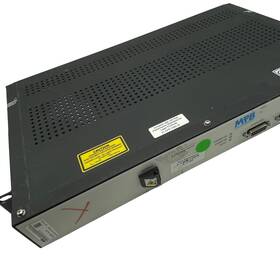
( Brand: Mpb Communications ), ( Manufacturer Part Number: 1RUEBS4010ACCA ), ( Unit Type: Unit )
Review MPB COMMUNICATIONS Erbium Broadband Source Ebs C band 250v
The **MPB Communications 1RUEBS4010ACCA (1RU-EBS-4010-AC-CA) Erbium Broadband EBS C-Band Amplifier** is a high-performance, compact, and versatile optical amplification solution designed to deliver exceptional signal gain and reliability in modern telecommunications and data center infrastructures. Engineered for seamless integration into C-band (1530 1565 nm) fiber optic networks, this 1RU rack-mountable amplifier excels in boosting signal strength while maintaining low noise figures and minimal distortion, making it an ideal choice for long-haul transmission, metro networks, and dense wavelength division multiplexing (DWDM) systems. With a robust **250V AC power input**, the unit ensures stable operation in demanding environments, offering flexibility for deployment in both indoor and outdoor settings where consistent power availability is critical. Its **Erbium-doped fiber amplifier (EDFA) technology** provides broad bandwidth amplification, efficiently compensating for signal attenuation over extended fiber spans, thereby enhancing network capacity and reducing the need for costly repeaters. The amplifier s advanced design incorporates **automatic gain control (AGC)** and **tunable gain flattening filters**, ensuring optimal signal integrity across varying input power levels and wavelength distributions. Built with high-quality components and rigorous thermal management, the 1RUEBS4010ACCA delivers long-term reliability and minimal maintenance requirements, making it a cost-effective solution for operators seeking to maximize their network s performance and scalability. Whether deployed in core transport networks, data center interconnects, or hybrid fiber-coaxial (HFC) systems, this amplifier s precision engineering and adaptability ensure seamless signal amplification, reduced latency, and improved overall network efficiency.
### **Pros and Cons of buying a MPB Communications 1RUEBS4010ACCA (1RU-EBS-4010-AC-CA) Erbium Broadband EBS C-Band Amplifier**
#### **Overview**
The **MPB Communications 1RUEBS4010ACCA** is a **C-band erbium-doped fiber amplifier (EDFA)** designed for broadband applications, including satellite communications, fiber optic networks, and distributed antenna systems (DAS). It amplifies signals in the **C-band (1530 1565 nm)** with high gain, low noise, and robust performance. Below is a detailed analysis of its advantages and limitations.
---
### **Pros**
1. **High Gain and Low Noise Figure**
- The amplifier provides ** 40 dB of gain**, which is essential for long-haul fiber optic transmissions where signal attenuation is significant.
- A **low noise figure ( 4.5 5.5 dB)** ensures minimal degradation of the input signal, improving overall system performance.
2. **Compact and Space-Efficient Design**
- The **1RU form factor** makes it suitable for rack-mounted installations in telecom data centers, satellite earth stations, or DAS deployments where space is limited.
- Compact size reduces infrastructure costs compared to larger, multi-unit amplifier systems.
3. **Wide Input Power Handling**
- Capable of handling **high input power levels (typically -30 dBm to 10 dBm)**, making it versatile for different signal strengths without requiring pre-amplification.
- Useful in scenarios with varying signal conditions, such as satellite uplinks or fiber backhaul.
4. **Erbium-Doped Fiber Technology**
- **EDFAs** are industry-standard for broadband amplification due to their **broad bandwidth, high efficiency, and reliability**.
- Provides **flat gain across the C-band**, ensuring consistent performance for multiple channels (e.g., in DWDM systems).
5. **High Reliability and Durability**
- Designed for **24/7 operation** with minimal maintenance requirements, making it ideal for mission-critical applications.
- **Wide operating temperature range** (typically -10 C to 50 C) ensures stability in varying environmental conditions.
6. **Modular and Scalable**
- Can be **combined with other amplifiers** (e.g., L-band, O-band) for extended coverage in multi-band systems.
- Supports **remote monitoring and control** via management interfaces (e.g., SNMP, CLI), allowing for network optimization.
7. **Low Power Consumption**
- Compared to older amplifier technologies, EDFAs like this one are **energy-efficient**, reducing operational costs in large-scale deployments.
8. **Backward and Forward Compatibility**
- Works with **standard C-band transponders, lasers, and modulators**, ensuring compatibility with existing infrastructure.
- Can be integrated into **hybrid fiber-coaxial (HFC) networks** or **satellite ground stations** with minimal modifications.
9. **Long Lifespan and Low Maintenance**
- **Erbium-doped fiber** has a **long operational lifespan** (typically 10 years with proper cooling).
- Fewer moving parts mean **reduced failure risk** compared to mechanical amplifiers.
10. **Support for Modern Telecom Standards**
- Compatible with **DWDM (Dense Wavelength Division Multiplexing), CATV, and fiber-to-the-home (FTTH)** applications.
- Can be used in **5G backhaul, enterprise networks, and cloud connectivity** due to its high-speed amplification capabilities.
---
### **Cons**
1. **Limited to C-Band Only**
- Unlike multi-band amplifiers (e.g., C L-band), this unit **does not cover the L-band (1565 1625 nm)**, restricting its use in systems requiring extended bandwidth.
- If future expansion into L-band is needed, a separate amplifier would be required.
2. **Higher Upfront Cost**
- Compared to simpler **gain blocks or semiconductor optical amplifiers (SOAs)**, EDFAs like this one are **more expensive** due to advanced erbium doping and precision engineering.
- May not be cost-effective for **small-scale or low-bandwidth applications**.
3. **Requires Proper Cooling**
- While EDFAs are efficient, **excessive heat buildup** in high-gain configurations can degrade performance over time.
- **Active cooling (e.g., fans or liquid cooling)** may be necessary in dense rack environments, adding complexity.
4. **Signal Distortion at High Input Powers**
- If the input signal is **too strong (e.g., > 10 dBm)**, it can lead to **nonlinear effects** such as **cross-gain modulation (XGM) or cross-phase modulation (XPM)**, distorting the output.
- Requires **precise input power management** to maintain signal integrity.
5. **Dependence on Fiber Quality**
- Performance degrades if the **input/output fibers are dirty, damaged, or improperly connected**, leading to **insertion loss**.
- Requires **high-quality connectors (e.g., FC/APC, SC/APC)** and **regular cleaning** to prevent signal loss.
6. **Limited Gain Flatness in Some Configurations**
- While the amplifier is designed for **flat gain across the C-band**, slight variations may occur at the **band edges (1530 nm and 1565 nm)**.
- May require **gain equalization filters** for ultra-high-precision applications (e.g., DWDM with tight channel spacing).
7. **Potential for Polarization-Dependent Gain (PDG)**
- Some EDFAs exhibit **slight polarization sensitivity**, meaning gain may vary slightly based on the input signal s polarization state.
- While minimal in modern designs, **polarization controllers** may be needed in sensitive applications.
8. **Vendor Lock-In Risks**
- MPB Communications is a **specialized manufacturer**, and compatibility with **third-party components** (e.g., lasers, modulators) may not always be guaranteed.
- **Spare parts and long-term support** may be limited compared to broader telecom vendors (e.g., Ciena, Nokia, Huawei).
9. **Not Ideal for Ultra-Low Noise Applications**
- While the noise figure is low ( 4.5 5.5 dB), **ultra-sensitive applications** (e.g., quantum communications, deep-space optics) may require **even lower noise amplifiers** (e.g., semiconductor-based or cryogenic amplifiers).
10. **Installation and Configuration Complexity**
- Setting up an EDFA requires **proper alignment, polarization adjustment, and gain optimization**, which may necessitate **specialized training**.
- **Mistakes in configuration** (e.g., incorrect input power, improper fiber splicing) can lead to **permanent damage** to the amplifier.
---
### **Conclusion**
The **MPB Communications 1RUEBS4010ACCA** is a **high-performance, reliable, and compact C-band EDFA** well-suited for **broadband amplification in telecom, satellite, and fiber optic networks**. Its **high gain, low noise, and robust design** make it an excellent choice for **long-haul transmissions, DWDM systems, and DAS deployments** where signal integrity is critical.
However, its **limited C-band coverage, higher cost, and dependency on proper installation** may pose challenges in **small-scale or multi-band applications**. Additionally, **cooling requirements and potential polarization effects** must be carefully managed to ensure optimal performance.
For **mission-critical, high-bandwidth applications** where **reliability and low noise are prioritized**, this amplifier is a **strong recommendation**. Conversely, **budget-conscious or low-bandwidth deployments** may find more cost-effective alternatives (e.g., gain blocks or hybrid amplifiers).
---
### **Final Recommendation**
**Buy the MPB Communications 1RUEBS4010ACCA if:**You require **high-gain, low-noise C-band amplification** for **DWDM, satellite, or fiber backhaul**.
Your application demands **compact, rack-mountable equipment** with **long-term reliability**.
You are working in an **environment where signal integrity is paramount** (e.g., enterprise networks, 5G backhaul).
You have **proper cooling and fiber management** in place to prevent performance degradation.
**Avoid or Consider Alternatives if:**You need **L-band or multi-band coverage** (consider a **C L-band EDFA** instead).
Your budget is **constrained**, and a **lower-cost gain block or SOA** would suffice.
You lack **expertise in fiber optics and amplifier configuration** (training may be required).
Your application involves **ultra-low noise or polarization-sensitive signals** (evaluate **semiconductor amplifiers or cryogenic EDFAs**).
**Best For:**- **Telecom carriers** deploying **DWDM or fiber-to-the-home (FTTH)**.
- **Satellite operators** requiring **high-gain C-band amplification** for uplinks/downlinks.
- **Data center and cloud providers** needing **low-latency, high-capacity fiber links**.
- **Distributed antenna system (DAS) deployments** where **compact and efficient amplification** is needed.
**Alternative Considerations:**- For **L-band support**, look at **MP
Details:
With a compact unit type and brand known for reliability, this C-band 250V laser source provides consistent efficient performance. Perfect for businesses and organizations looking to enhance their optical communication systems, this erbium broadband source offers a reliable versatile solution range of applications. Please refer to the photos.
part #: 1ruebs4010acca prices
- $1679.18-$1865.00
specifications industrlasemr:
- brand: Mpb Communications
- mpn: 1ruebs4010acca
- unit type: Unit
seller industrlasemr:
- # reviews: 9091
- city: Garfield, New Jersey
- rating: 99.5%
returns industrlasemr:
- method: Money back
- paid by: Seller
- time: 30 Days
- policy: Returns Accepted
payments industrlasemr:
- credit card: Diners-club
- other
- wallet: Apple-pay
shipping industrlasemr:
- class: Standard
- cost: $0.00
- transit: 4-10 Days
- type: Fixed
- service: Standard
general industrlasemr:
- Medical/Lab Equipment Attachments Accessories > Lamps, Bulbs Laser Components > Laser Modules Heads
- condition: Used
offer industrlasemr:
- sold: 0
- best offers: True
- started: March 31, 2026
- quantity: 1
- availability: In Stock
- options: Ship-to-home
Mpb Communications 1RUEBS4010ACCA Is Similar To:
- Vfl-p-1000-642-oem1 Mpb Communications Vfl-p Series W (34.5% similar) You are buying on a Mpb Communications VLF-p OEM1 series w oem laser module. There are some very light scratches and or scuff marks on the unit from normal use...(February 16th, 2017)
- Vfl-p-1000-642-oem2 Mpb Communications Vfl-p Series W (34.5% similar) There are some very light scratches and or scuff marks on the unit from normal use. You are buying on a Mpb Communications VLF-p OEM2 series w oem laser module...(February 28th, 2017)