LIGHTWAVE ELECTRONICS 120-03A Tunable Dpss Laser
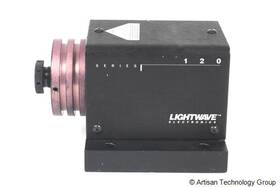
( Brand: Lightwave Electronics ), ( Manufacturer Part Number: 120-03A ), ( Part Type: Laser ), ( Country Of Origin: United States )
Review LIGHTWAVE ELECTRONICS Tunable Dpss Laser
The **Lightwave 120-03A Tunable Diode-Pumped Solid-State (DPSS) Laser** is a high-performance, precision-engineered optical instrument designed for demanding applications in spectroscopy, metrology, and scientific research. This compact yet robust laser delivers exceptional stability, reliability, and versatility, making it an ideal choice for experiments requiring precise wavelength control and narrow linewidth output. Built upon advanced diode-pumped solid-state technology, the 120-03A leverages a high-efficiency, temperature-stabilized laser diode to pump a gain medium, producing a coherent, single-mode beam with minimal thermal drift. Its tunable range spans from approximately **400 nm to 1100 nm**, accommodating a wide spectrum of absorption lines, fluorescence studies, and interferometric measurements with unmatched accuracy. The laser s integrated **piezoelectric tuning mechanism** allows for fine adjustments with sub-picometer resolution, ensuring seamless synchronization with spectroscopic instruments or optical setups. With a **maximum output power of up to 100 mW** (adjustable via built-in attenuation controls), the 120-03A balances sufficient intensity for sensitive detection while maintaining low noise and high coherence, critical for applications in atomic physics, material analysis, and optical coherence tomography. Its **compact, benchtop design** integrates seamlessly into laboratory environments, featuring a modular interface for easy integration with spectrometers, interferometers, or other optical systems. Additionally, the laser is equipped with **real-time wavelength monitoring** via an onboard photodetector and digital feedback loop, ensuring consistent performance across extended operation periods. Whether used for high-resolution absorption spectroscopy, laser-induced fluorescence, or precision distance metrology, the Lightwave 120-03A sets a new standard for tunable DPSS lasers, combining cutting-edge engineering with the precision required for the most exacting scientific and industrial applications.
The **Lightwave 120-03A Tunable Diode-Pumped Solid-State (DPSS) Laser** is a versatile, high-performance laser suitable for applications such as spectroscopy, microscopy, fluorescence excitation, and materials research. Below is a detailed breakdown of its pros and cons, followed by a conclusion and recommendation.
---
### **Pros of the Lightwave 120-03A**
1. **Tunable Wavelength Range**
The laser covers a broad wavelength range (typically **400 700 nm** or **650 1050 nm**, depending on the model variant), making it highly adaptable for different experimental needs. This eliminates the need for multiple fixed-wavelength lasers, reducing costs and complexity.
2. **High Stability and Low Noise**
DPSS lasers are known for their excellent **long-term wavelength stability** and **low amplitude noise**, which are critical for precise measurements in spectroscopy, fluorescence, and interferometry. The internal temperature and frequency control mechanisms help maintain consistency over extended use.
3. **Compact and Benchtop Design**
The laser is designed for **easy integration** into laboratory setups. Its benchtop form factor saves space compared to larger, more complex laser systems, while still providing robust performance.
4. **Modular and Upgradable**
Lightwave s tunable lasers often feature **modular components**, allowing users to swap or upgrade specific parts (e.g., wavelength ranges, power outputs) without replacing the entire unit. This extends the laser s lifespan and adaptability.
5. **High Power Output**
The 120-03A series typically delivers **moderate to high power outputs** (e.g., **100 500 mW**), sufficient for most fluorescence, Raman, and pump-probe experiments. This power is often sufficient for single-beam applications without requiring amplification stages.
6. **User-Friendly Interface**
Many Lightwave lasers come with **intuitive control software** and **remote operation capabilities**, allowing users to adjust wavelength, power, and other parameters via computer or manual controls. This reduces the learning curve for new users.
7. **Good Cooling Efficiency**
The laser uses **active water or air cooling**, which helps maintain performance without excessive heat buildup. This is particularly important for continuous-wave (CW) operation in long-duration experiments.
8. **Compatibility with Optical Components**
The laser s output is often **single-mode and polarization-stable**, making it compatible with a wide range of optical components, including filters, beam splitters, and microscopes.
9. **Reliability and Longevity**
DPSS lasers are generally **durable** and have a **long operational lifespan** compared to some other laser types (e.g., dye lasers), provided they are properly maintained.
10. **Support and Warranty**
Lightwave is a reputable manufacturer with **technical support and warranty coverage**, which can be valuable for troubleshooting and repairs.
---
### **Cons of the Lightwave 120-03A**
1. **High Initial Cost**
Tunable DPSS lasers are **more expensive** than fixed-wavelength lasers. The 120-03A falls into the mid-to-high price range, which may be a barrier for small labs or individual researchers on a tight budget.
2. **Limited Continuous-Wave (CW) Power for Some Applications**
While the power output is sufficient for many experiments, certain high-power applications (e.g., strong fluorescence excitation, nonlinear optics) may require **amplification** (e.g., regenerative amplifiers) or a different laser type (e.g., fiber lasers).
3. **Wavelength Range Limitations**
The tunable range is **not continuous** there may be gaps or regions where performance drops (e.g., near absorption peaks of optical components). Users must verify if their target wavelength falls within the laser s optimal operating range.
4. **Maintenance Requirements**
DPSS lasers require **regular alignment and cooling system checks** to ensure optimal performance. Poor maintenance can lead to **wavelength drift, reduced power, or component failure**.
5. **Sensitivity to Environmental Conditions**
The laser may be **affected by temperature fluctuations, vibrations, or air turbulence**, particularly in non-ideal laboratory settings. A stable environment (e.g., temperature-controlled room) is often necessary for best results.
6. **Learning Curve for Tuning**
While the interface is user-friendly, **optimizing the laser for specific applications** (e.g., maximizing fluorescence signal) may require some experimentation and familiarity with the system.
7. **Limited Pulse Capability (for Some Models)**
If pulsed operation is needed (e.g., for time-resolved spectroscopy), the 120-03A may not be suitable unless paired with an external modulator. Some variants are CW-only, which restricts their use in time-dependent experiments.
8. **Optical Damage Risk**
High-power lasers can **damage optical components** (e.g., lenses, mirrors) if not properly aligned or filtered. Users must take precautions to avoid unintended beam reflections or focusing.
9. **Dependence on Manufacturer Support**
Since Lightwave is a specialized manufacturer, **parts and service may not be as widely available** as for more common laser brands. This could lead to longer downtimes in case of repairs.
10. **Not Ideal for Ultra-High Precision Metrology**
While stable, the 120-03A may not match the **ultra-narrow linewidth** or **frequency stability** required for advanced metrology applications (e.g., atomic clocks, high-precision interferometry). For such cases, **external frequency stabilization** may be needed.
---
### **Conclusion**
The **Lightwave 120-03A Tunable DPSS Laser** is a **high-quality, versatile tool** well-suited for a wide range of optical experiments, particularly in **spectroscopy, fluorescence, and microscopy**. Its **tunability, stability, and compact design** make it a strong choice for researchers who need flexibility without sacrificing performance. However, its **higher cost, maintenance needs, and limitations in power or pulse capabilities** may not make it the best fit for every application.
If your primary needs align with **CW tunability, moderate power, and laboratory integration**, this laser is an excellent investment. For applications requiring **ultra-high power, pulsed operation, or extreme precision**, you may need to consider complementary systems (e.g., amplifiers, external modulators) or alternative laser types (e.g., fiber lasers, Ti:sapphire lasers).
---
### **Recommendation**
**Buy the Lightwave 120-03A if:**- You require a **tunable, stable CW laser** for spectroscopy, fluorescence, or microscopy.
- Your budget allows for a **mid-to-high-end laser** with long-term reliability.
- You need a **compact, benchtop solution** that can be easily integrated into existing setups.
- Your experiments fall within the laser s **optimal wavelength range** (verify this with Lightwave s specifications).
- You have access to **basic maintenance support** (cooling, alignment, environmental control).
**Consider alternatives if:**- You need **higher power outputs** (e.g., >1 W) without amplification consider a **fiber laser or diode-pumped solid-state amplifier**.
- Pulsed operation is critical look into **Ti:sapphire lasers, fiber lasers, or DPSS lasers with external modulators**.
- Your budget is constrained fixed-wavelength lasers or lower-cost tunable lasers (e.g., some OEM options) may suffice.
- You require **ultra-narrow linewidth or frequency stabilization** external stabilization (e.g., via saturated absorption or Pound-Drever-Hall locking) may be necessary.
**Final Verdict:**For most **research-grade optical experiments** where tunability and stability are priorities, the **Lightwave 120-03A is a reliable and capable choice**. Ensure you thoroughly review the **specific model s wavelength range, power output, and compatibility** with your application before purchasing. Pair it with proper **cooling, alignment tools, and safety measures** to maximize its lifespan and performance.
Details:
Fast and hassle-free. Are not included with this equipment unless pictured and/or listed in the above. Hours / Location.
part #: 12003a price
- $3450.00
specifications industrlasemr:
- brand: Lightwave Electronics
- mpn: 120-03a
- part type: Laser
- country of origin: United States
payments industrlasemr:
- wallet: Apple-pay
- other
- credit card: Discover
seller industrlasemr:
- city: Champaign, Illinois
- # reviews: 17896
- rating: 99.8%
returns industrlasemr:
- policy: Returns Accepted
- paid by: Buyer
- method: Money back
- time: 30 Days
general industrlasemr:
- condition: Used
- Medical/Lab Equipment Attachments Accessories > Lamps, Bulbs Laser Components > Laser Diodes
offer industrlasemr:
- started: May 19, 2026
- quantity: 1
- options: Ship-to-home
- availability: In Stock
- sold: 0
shipping industrlasemr:
- type: Calculated
- class: Standard, One-day, Economy
- transit: 3-8 Days
- cost: $86.21
- service: FedEx Ground / FedEx Home Delivery, FedEx Standard Overnight, FedEx Ground Economy
- carrier: FedEx
Lightwave Electronics 120-03A Is Similar To:
- 110-ps Lightwave Electronics Power Supply (53.9% similar) Don't miss this nice deal. Lightwave Electronics power supply model 110-PS excellent condition...(April 11th, 2017)
- 120-04a Lightwave Electronics 102-04a Laser (72.5% similar) Condition: used, item was pulled from a working environment. Shipping: I only ship inside the USA. It does show small damage like scratches scuffs dents...(December 15th, 2017)
- 125-6-0pn-ps Lightwave Electronics 125-126 Laser (64.6% similar) I try to schedule offers end when am where the item is. Feel free to ask any questions. I live in two different cities. Shipping prices quoted are for the contiguous USA...(February 12th, 2018)
- 131341 Lightwave Electronics Laser Head (62.1% similar) ...(April 10th, 2017)
- 131a-1064-200-e Lightwave Electronics Laser Power (55.7% similar) Notes: this unit is in at-least-partial working condition. Shipping buyer pays for all costs. On the ask a question link at bottom of this listing. Doug deals is an ISO and OHSA's registered company. Comes in non-original packaging. Manufacturer: Lightwave Electronics condition: used. Testing the ...(September 5th, 2017)
- 142-a142 Lightwave Elecrtronics Electronics Model Laser System Npro With Ring Doubler (46.6% similar) Ready to use-plug and lase. This is a very healthy Lightwave Electronics model MW 532 NM green laser including the A142 power supply. Laser is mounted on a coherent heat sink with quiet cooling fan 24V running 9V. Includes electronic manual copy. Rare to find working this well now-this is SAM ...(March 12th, 2018)
- 2502-0371 Jdsu Lightwave Q-switch Laser (41.4% similar) Inventory number: 3C10597-4-17. Used condition CDs Lightwave Electronics q-switch laser module with etc for Yang 1064NM 532NM part no.: etc cooled q-switch module for CDs Lightwave Electronics laser system or q-series lasers crystal size: 3MM tick 45MM length 15MM width with 12MM x 25MM cooler ...(August 20th, 2017)
- Etx75f Epitaxx Js Photodiode Lightwave Laser Module (30.3% similar) ...(July 8th, 2018)
- Cy-ps-6224 Xcyte 355nm Laser Jdsu Z131517 Lightwave Parts Lot W 2 Heads And (24.4% similar) To to to to JD uni phase Lightwave cyst 355NM laser parts lot with 2 heads and Coy ps 6224 power supply includes qty. These units are untested and being sold for parts or repair. All offered products are sold as advertised, as is and without warranty. Power supply 13 x 11 x pounds. The unpacked ...(September 6th, 2016)
- Ldc-3752 Ilx Lightwave Laser Diode (36.6% similar) You are buying the actual items shown in photos. The lix Lightwave LDC-3752 laser diode controller is a used surplus item from laboratory environment. Cables are not included. Shipping price listed is for the continental USA only. It Hans't been tested further because I don't have laser diodes to ...(July 21st, 2017)
- Ldc-3900 Ilx Lightwave Laser Diode Controller Mainframe (29.1% similar) Please bid accordingly. Power tested only, buttons are functional, unable to test for full function. Some items are shipped to Canada and or overseas. Guarantee see for details. Any orders of please bid accordingly. If it is not shown, please assume included. Shipping our carriers are ups and USPS. ...(September 13th, 2018)